|
|

楼主 |
发表于 2009-7-30 20:51:09
|
显示全部楼层
来自: 中国浙江温州
/ w" y- g g1 k+ s$ o. x% o7 t$ L; y; a
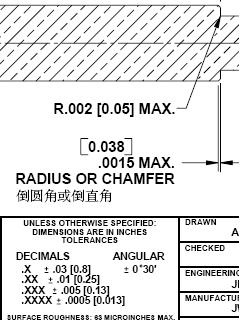
1 \$ k1 b6 d8 O/ L我也联系了美国的制图者,刚收到他的回复,基本和上述仁兄的分析吻合。 现分享下他的回复内容,如下:
- K# G. ?2 z, r& y! `+ C1 J3 h- ~4 x/ c
“
4 _. m* m6 Q0 Z; D) N8 PHi XXX,
' h* r1 t# @. R! _. R4 J; T" Q; x
7 l$ `: J8 j' V. ^" I
2 [2 d- ?# ]2 `, nAccording to ASME Y14.5-1994 para. 2.5, single limits dimensions such as those indicating MAX or MIN:
. @' h, b/ ?9 ^/ `9 B: Z. y# {0 z, q3 }% e2 ?% H W+ ~) R
! X* w. M. p" }" O' Y
“Single limits are used where the intent will be clear, and the unspecified limit can be zero or approach infinity and will not result in a condition detrimental to the design.”2 e1 }. p: H7 Q* m& ]3 C' T
& {4 i C2 R. e" }/ j; t* d m) _2 S; \
Therefore, the .0015 max. radius or chamfer on drawing does not require a radius or chamfer, and the edge can be sharp, but if a radius or chamfer is present, it must not be any larger than .0015 [0.038 mm].
/ {! E: ?( e7 b) M4 ~" J/ ]# j
( e4 a8 _6 d+ y7 t, M/ h
+ }& d0 \1 _! g7 MI hope this answers your question, but if it is still unclear let me know and I will try to explain further.
5 L& y7 B; {* o9 H) m" Z
- Q4 `7 _$ i1 C6 u) p) Z+ [3 J
# z! i5 j, v4 k: a' m4 |Thanks/ c4 a: n5 C! a/ ~, S. i7 A$ B1 x& K
XXX
, Z, u+ A9 } s”9 ] h2 t. [) O
[! T. D+ ~% h
谢谢大家的关注!
8 d/ j }) K9 |. x3 ?" u, P1 K1 _2 l. ~/ u! A3 t% H
[ 本帖最后由 wangyanwei 于 2009-7-30 20:53 编辑 ] |
|







 发表于 2009-7-30 14:34:47
 :P :P :P :P