|
|
马上注册,结识高手,享用更多资源,轻松玩转三维网社区。
您需要 登录 才可以下载或查看,没有帐号?注册

x
全书4个压缩卷,解压后7.91M: s9 D2 Q' h2 x+ O5 J
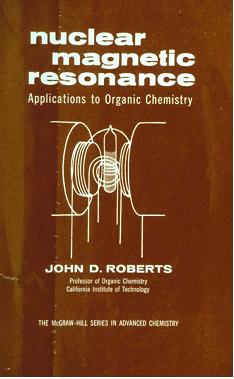
书名Nuclear Magnetic Resonance applications to organic chemistry/ W' L! B- ^8 K& b5 h+ ^$ B+ n2 `
作者John ID. Roberts 6 ?( P' O0 g& t7 Y
出版社McGRAW-HILL BOOK COMPANY, IN; G5 A, x5 U9 A& Q# H
出版日期1959) v! \% y. K" U" n1 Z: D3 }: I
出版号 58-138885 {9 m& }1 R1 A! z4 B: @
页数133
' b% C9 \8 {- Y! F( L0 A% b$ g内容简介
9 B; a- g: h% b% |This brief book is the outgrowth of some forty lectures in which it was . i% `. _% Q0 X+ Q( r
attempted to explain the phenomenon of nuclear magnetic resonance
9 S5 Q8 ] E4 s. c( C: A! V- pabsorption and the uses of high-resolution nuclear magnetic resonance
% D% c' L0 x5 D6 X& ~1 v5 Q9 U6 \9 Ispectroscopy to organic chemists whose background, like that of the , ^" ?& a# w' _1 H8 X+ I
author, has often been deficient in nuclear and-qlectromagnetic theory. 5 W; l1 B! ?; @; x
Quite a number of suggestions were received for presentation of the
& Q' P& t+ y6 |8 e1 Bmaterial in printed form with illustrations based on the lecture slides. u6 {3 D0 D. K
This has now been done, and it is hoped that the result will bepf service
, ?1 U- m) y8 x4 N2 u1 v! `: k8 S! oo practicing chemists and students as a guide to various applic+ns of - d# H/ t- s: J* |% ]& n
NMR spectroscopy and an introduction to more authoritative works. ! U4 G* y$ x8 J3 v6 m7 t h9 Q
Throughout, the coverage is illustrative rather than comprehensive.
& S; q/ c4 K/ N2 \7 c7 v$ y目录
' _+ E( t r3 D6 \- U9 ^! w) \8 u1 . Introduction . The Nuclear Resonance Phenomenon
0 u; ^. C; g8 c4 {: Y( z1.1 . Introduction ........... / y# J2 ~' Z. V% m B% y* {( ?& Z2 {
1.2 . Nuclear Magnetic Resonance Spectrometers .
3 R7 {* _ P# D1.3 . Magnetic Properties of Nuclei . Nuclear Spin ! O/ P1 z0 r& _2 E4 y' c! s; b
1.4 . Magnetic Quantum Numbers ...... % n9 d% A& Q( H5 t. W* I/ P/ U8 ^
1.5 . Nuclear Precession ......... 3 o. v; x+ U5 F4 J
1.6 . Nuclear Relaxation ......... ) l# R Z# N" t( j. L" i
1.7 . Longitudinal Relaxation, TI ......
/ b: G- M2 g! `& \ q1.8 . Transverse Relaxation, T, ....... % M. w: ~) u4 _
1.9 . The Nuclear Resonance Signal .....
$ ?' H$ J' H" r5 ?+ a1.10 . Relaxation Effects on NMR Signals .... 5 l+ @0 g H- s9 f
1.11 . Properties of Magnetic Nuclei of Interest to
2 W! `2 U2 [' L5 d5 l0 UOrganic Problems .......... . L; c4 z' e7 y9 x1 `
2 . The Chemical Shift ..............
7 |1 w' S) D4 t& ]2.1 . Introduction . The Chemical-shift Parameter .... 8 e9 ~; H! l; K% }, o7 r f
2.2 . Measurement of Chemical Shift . ....... # v3 n m9 z; q. ?- G+ h* F
2.3 . Some Factors Which Influence 6 .......
- x- }$ A1 M! w' d9 I/ L2 Y; `2.4 . Chemical Shifts for Other Nuclei ....... - L. ]( \2 X1 s6 V
2.5 . Proton 6 Values and Electronegativity ......
, h- y( p7 a8 A: N2.6 . 6 and Hammett's a Constants .........
. u) C/ x3 c3 M! ]2.7 . Resonance Signal Areas and Widths ...... 1 o# m# U& K3 S( _% [' N/ j
2.8 . Chemical Shifts and Organic Structure Determinations . % O, @, Q' {% Z2 p! v
General Considerations ..........
& D5 t3 e+ B/ n3 L2.9 . Illustrative Analysis of a Reaction Product ....
2 [( U. U; K) ~8 `: E# B4 Y- z2.10 . Accentuation of Chemical Shifts by Paramagnetic Salts
" {) S1 Y' m }: `3 i) i5 M3 . Spin-Spin Splitting ........... 5 j( ]! X+ W6 z; ]/ B! R0 A
3.1 . The High-resolution Ethanol Spectrum ... ..... 42
* Z) Y; C) p5 E# j3.2 . Spin-Spin Splitting in a Single Crystal ... ..... 43 ' m) ?" d) i3 @4 f
3.3 . Spin-Spin Splitting in Liquids ...... ..... 45
' j V" _* N' P3.4 . Spin-Spin Splitting in the Ethyl Group ... ..... 46 5 _8 D1 _ M0 H
3.5 . More Complex Spin-Spin Splittings .... ..... 48
' x$ {1 Q4 E* V# N& F3.6 . Magnitudes of Coupling Constants .... ..... 53
m6 C6 K3 u. ] ]! ^3.7 . Coupling between Equivalent and Nearly Equiv ,alent Protons . 55 " G( q1 U- E; E7 `7 m
3.8 . Spin-Spin Couplings in Rigid Systems ... .... 57 3 m, Q6 m5 a5 ?/ D' _* D
3.9 . Spin-Spin Splitting and Molecular Asymmetry ..... 58
/ G; w( W" h! V0 f7 \( T8 N4 . Nuclear Magnetic Resonance and Reaction Kinetics ..... 61
- {+ T/ C9 c; f4.1 . Introduction . Proton Exchange in Water-Acetic
) [5 b" C6 F3 R9 `2 S( _Acid Mixtures ................ 61 & A. Z: o' [) ]9 o
4.2 . Relationship between Resonance Line Shapes and 8 R3 R) c1 N! X' o' f3 {. R+ d
Exchange Rates ............... 63 7 \" G9 P6 C& t8 D
4.3 . Proton Exchange in Ethanol-Water Mixtures ..... 64
( ?3 D7 B. O; R* s) w q/ h& q4.4 . Ethyl Acetoacetate and Its En01 Form ........ 67
8 y/ ~3 v, `2 G5 A4.5 . Rates of Rotation Around 40-N< Bonds of Amides ... 69 6 Q o) l9 c# \
4.6 . Restricted Rotation in Ethane Derivatives ...... 71 0 G6 ?6 R }) m
4.7 . Nitrogen Inversion Frequencies of Cyclic Imines .... 74 + u9 N/ S* ^. [2 @: `4 b+ g3 ?% ?
4.8 . Proton Exchange in Ammonia and Ammonium Ions ... 76
1 }( s+ [. b& r" d! @; ]+ v5 . Nuclear Quadrupole Relaxation Effects . Double Resonance ... 80 6 Z, l9 Z6 e p& d
5.1 . Proton Resonance Line Broadening by 1iN ...... 80
' y, K. r; P) r" g. e* k5 w5 n* V5 w8 g5.2 . Nuclear Quadrupoles and Quadrupole-induced Relaxation . . 81 3 Q; R: }! U" E
5.3 . Proton N-K Resonance of Pyrrole . Double Resonance . . 83
# x4 F4 s: y+ K+ g# F5.4 . Quadrupole-induced Relaxation with Other Nuclei .... 84 ) m( U# O/ h+ T
5.5 . Applications of Double Resonance ......... 86
7 I1 u# |, Z4 |4 jAppendix A . The Bloch Equations ............ 88
) C% c5 B/ t0 F' a; p* cAppendix B . Bibliography .............. 99
8 H) u# J8 k, m: y: u6 _) V" qAppendix C . Problems ................ 100 8 D) {" I" ^. g" H
Name Index ................... 111 5 a- X4 I2 ]0 f! u" `% H
Subject Index ................... 113 |
评分
-
查看全部评分
|


 [复制链接]






 发表于 2008-6-26 15:39:16